Rubber processing is becoming more demanding as manufacturers pursue cleaner cuts, lower waste, and longer tool life. Smithers’ market reports describe steady expansion in global rubber consumption, supported by automotive, medical, construction, and industrial applications. Grand View Research also identifies compound development and advanced converting equipment as important growth factors. These trends make knife selection more technical than it appears.
Carbide Knives For Rubber Cutting can provide high hardness, edge stability, and improved resistance to abrasive fillers. However, carbide is not automatically the best choice. A blade used on soft silicone may behave differently from one cutting reinforced conveyor rubber. Silica, carbon black, fabric cords, temperature, and cutting speed all affect performance. Small details matter.
The wrong geometry creates tearing, heat marks, or premature chipping.
This 2026 guide examines carbide grade, edge angle, coating, blade thickness, and cutting method. It also considers rotary slitting, guillotine cutting, and automated sheet processing. Technical recommendations should be checked against supplier test data, ISO-related quality procedures, and the actual rubber compound. Published market forecasts are useful, but they often use different definitions and time periods. That limitation deserves attention.
In practical trials, a clean edge after 10,000 cuts may matter more than a lower purchase price. Operators should record cutting force, burr formation, temperature, and replacement intervals. Tool life claims can vary sharply between laboratories and factories. Therefore, reliable selection combines manufacturer expertise, controlled testing, and measurable production evidence. This approach supports safer decisions, consistent quality, and more realistic cost calculations.
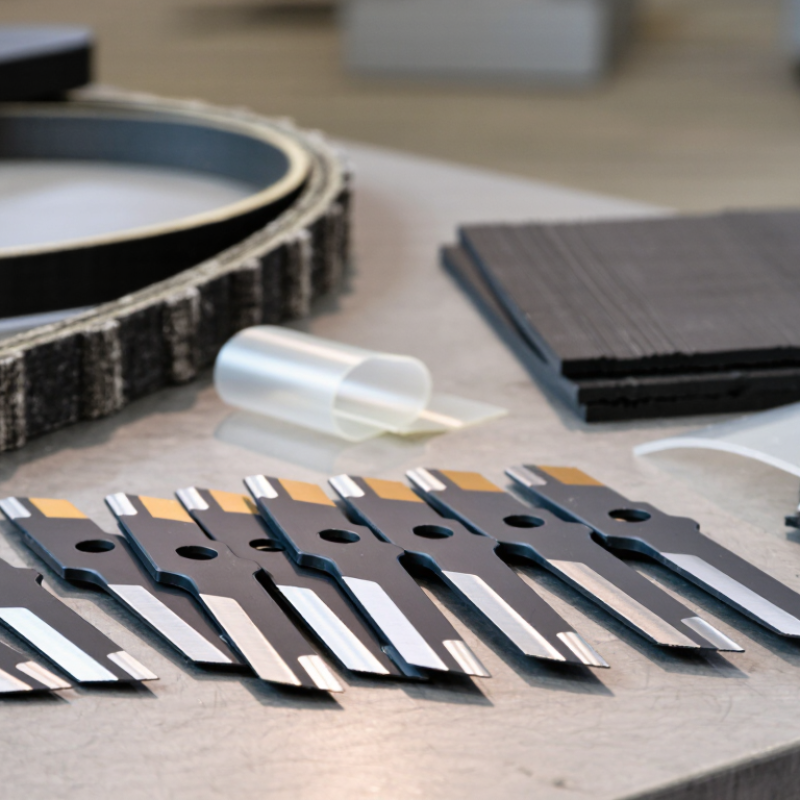
Carbide knives use a cutting edge made from cemented tungsten carbide, not ordinary tool steel. Hard carbide particles are bonded with a metallic binder, creating a dense edge that resists abrasion. The USGS Mineral Commodity Summaries 2025 reports global tungsten mine production at approximately 81,000 metric tons in 2024. That limited resource helps explain why carbide components are engineered for long service, rather than treated as disposable parts.
Rubber is difficult to cut cleanly. It stretches, rebounds, and can generate heat along the edge. Carbide knives keep their geometry under repeated contact, especially when cutting reinforced sheets, seals, belts, or dense recycled rubber. The International Rubber Study Group’s 2024 outlook places global rubber demand above 30 million tonnes annually. Even small reductions in trimming waste can therefore matter across high-volume production lines. A sharp edge also reduces tearing and loose fragments.
Hardness is not everything. A very brittle carbide edge may chip when it meets metal staples, fabric cords, or uneven surfaces. Practical selection should consider carbide grade, edge angle, knife thickness, cutting speed, and cooling. Trial cuts are essential. They expose problems that specifications miss. In some workshops, a slightly tougher grade performs better than the hardest available option. The best knife is not always the one with the longest theoretical life.
Cemented carbide knives are cutting tools made from hard carbide particles bonded with a metal binder. Their high hardness helps maintain a sharp edge when cutting abrasive rubber compounds, reinforced rubber, seals, belts, and thick sheets.
The chart shows representative Vickers hardness values in HV30. Actual hardness varies according to carbide grade, binder content, heat treatment, and material composition. For rubber cutting, select the knife geometry and carbide grade according to rubber hardness, reinforcement, thickness, cutting speed, and required edge life.
Rubber hardness is the first property to check, but it should not decide everything. ASTM D2240 measures Shore hardness, commonly from soft 20 Shore A compounds to hard 90 Shore A grades. Soft rubber can wrap around a knife edge and create drag. Hard rubber may resist penetration and chip a poorly supported edge. A carbide knife usually needs a sharper edge for soft sheets, while harder compounds often need stronger edge support.
Tensile strength, elongation, and tear resistance reveal how rubber will separate during cutting. ISO 37 measures tensile behavior, while ISO 34-1 evaluates tear strength. High elongation can make rubber stretch before severing, leaving long fibers or a distorted edge. High tear resistance may require a more rigid carbide geometry. It sounds simple. It is not. I have seen two compounds with identical Shore hardness cut very differently because one contained more reinforcing filler.
Abrasion and temperature also influence carbide selection. ASTM D5963 evaluates abrasion resistance, which matters when fillers or textured surfaces rub continuously against the knife. Cutting tests should include the actual production temperature, because rubber softens and becomes tackier as heat builds. The International Rubber Study Group’s 2024 outlook estimated global rubber demand at about 31 million metric tons, reflecting a wide mix of natural, synthetic, and filled compounds. That variety makes a single “best” carbide knife unrealistic. Measure hardness, elongation, tear strength, filler content, and operating temperature together. A clean laboratory sample can still mislead.
Use the rubber properties below to match hardness, toughness, edge geometry, and carbide grade with the cutting conditions.
| Rubber Property or Cutting Condition | Typical Real-World Range or Classification | Why It Matters During Cutting | Recommended Carbide Knife Direction | Suggested Edge Geometry | Practical Selection Notes |
|---|---|---|---|---|---|
| Shore A Hardness |
20–40 Shore A soft rubber 40–70 Shore A medium rubber 70–95 Shore A hard rubber |
Soft rubber tends to compress, stretch, and deform around the edge. Hard rubber requires higher edge strength and can generate more cutting resistance. |
Soft grades: use a very sharp, polished edge with high wear resistance. Hard grades: use a tougher carbide grade with stronger edge support. |
Soft rubber: approximately 20–30° included edge angle. Hard rubber: approximately 30–45° included edge angle. |
Shore hardness alone is not sufficient. Confirm the material's elasticity, filler content, thickness, and temperature before finalizing the knife. |
| Tensile Strength | Common elastomer compounds may range from approximately 5–30 MPa, depending on polymer type and formulation. | Higher tensile strength can increase resistance to crack initiation and make the rubber more difficult to separate cleanly. | Select a fine-grain carbide with a stable cutting edge and adequate transverse rupture strength. Avoid an excessively thin edge when the material is highly reinforced. | Approximately 25–40° included edge angle for general sheet and strip cutting. | A clean cut may require a slicing action rather than a straight vertical push, especially with high-strength rubber sheets. |
| Elongation at Break | Approximately 100–800% for many flexible rubber compounds; actual values vary substantially by formulation. | High elongation causes the material to pull, stretch, and recover after the knife passes, which can lead to dimensional variation and an uneven cut surface. | Use a highly polished carbide edge with low friction. A slicing or oscillating motion is often preferable to a purely compressive cut. | Approximately 20–35° included edge angle, with a polished or low-roughness face. | Reduce clamping distance and control material tension. Cutting unsupported, highly elastic rubber can produce inaccurate dimensions even with a sharp knife. |
| Tear Strength | Many rubber compounds fall within approximately 10–100 kN/m, depending on polymer, cure system, and reinforcement. | High tear strength can prevent the cut from propagating smoothly and may cause the rubber to pull or split away from the intended cut line. | Choose a tough carbide grade and a sharp, well-supported edge. For thick rubber, consider an oscillating or guided cutting process. | Approximately 30–45° included edge angle for thick or tear-resistant rubber. | Avoid a fragile micro-edge if the knife may encounter trapped tension, uneven thickness, or hard inclusions. |
| Abrasive Filler Content | Common fillers include carbon black, silica, clay, calcium carbonate, and short fibers. Mineral-filled compounds may contain approximately 10–60 phr filler, depending on the formulation. | Hard fillers increase abrasive wear, edge rounding, and the risk of micro-chipping at the cutting edge. | Prioritize fine-grain, wear-resistant carbide. Use a slightly more robust edge than for unfilled rubber and inspect the edge regularly. | Approximately 30–45° included edge angle; avoid an unsupported ultra-fine edge. | Abrasion resistance and edge retention become more important than maximum initial sharpness when cutting filled or reinforced compounds. |
| Reinforcement | Rubber may contain textile, polyester, nylon, aramid, steel cord, or glass-fiber reinforcement. | Reinforcement can create severe impact loading, localized chipping, or rapid wear. Steel and glass fibers are particularly demanding. | Use a tougher carbide grade with strong edge support. For steel-reinforced rubber, verify that carbide is suitable for the actual wire diameter and cutting method. | Approximately 35–50° included edge angle, depending on reinforcement and knife support. | Do not select a thin, razor-like edge solely for sharpness. Use secure clamping and avoid lateral impacts during the cut. |
| Coefficient of Friction and Tack | There is no single universal value. Uncured and tacky compounds generally create more surface drag and adhesion than cured, dry rubber. | High tack can cause material pickup on the knife face, dragging, surface tearing, and inconsistent feed. | Select a polished carbide surface and consider a low-friction coating compatible with the rubber formulation and operating temperature. | Approximately 20–35° included edge angle with a smooth relief face. | Keep the blade clean. Air cooling, suitable release media, or controlled lubrication may help, but compatibility with the rubber must be confirmed. |
| Material Temperature | Cutting conditions may range from approximately 10–80°C. Rubber becomes softer and tackier when heated and stiffer when cooled. | Temperature changes alter hardness, elasticity, friction, and dimensional recovery, which directly affects cutting force and cut quality. | For warm, tacky rubber, use a polished, low-friction edge. For cold, stiff rubber, use a tougher edge with adequate support. |
Warm rubber: approximately 20–35° included edge angle. Cold or stiff rubber: approximately 30–45° included edge angle. |
Test the knife at the actual production temperature. A knife selected at room temperature may behave differently in heated or chilled processing. |
| Rubber Thickness |
Thin film: below 1 mm Sheet and gasket stock: approximately 1–10 mm Thick blocks or profiles: above 10 mm |
Increasing thickness raises cutting force, deflection, heat generation, and the risk of incomplete separation. |
Thin material: sharp fine edge and precise support. Thick material: tougher carbide, deeper side clearance, and a guided or oscillating cutting motion. |
Thin stock: approximately 20–30° included edge angle. Thick stock: approximately 30–45° included edge angle. |
For thick rubber, check knife rigidity and holder alignment in addition to carbide grade. Excessive blade deflection can cause tapered cuts. |
| Cure State | Uncured rubber is generally softer and more tacky. Cured rubber has more stable dimensions and a defined elastic hardness. | Uncured material may smear or adhere to the blade, while cured material may produce more predictable but sometimes higher cutting resistance. |
Uncured rubber: polished, low-friction carbide with strong anti-adhesion performance. Cured rubber: balance sharpness, toughness, and wear resistance. |
Uncured: approximately 20–35° included edge angle. Cured: approximately 25–45° included edge angle. |
Confirm whether the process occurs before or after vulcanization; this factor can change the preferred edge finish and cutting speed. |
| Required Cut Quality | Common requirements include rough separation, gasket sealing edges, film slitting, profile trimming, or optical-quality surfaces. | A sealing or visible edge requires lower burr formation, minimal tearing, and consistent dimensional control. | For precision cuts, use fine-grain carbide, a polished edge, accurate holder alignment, and scheduled edge inspection. | Approximately 20–35° included edge angle for clean, low-force cutting when the material is not highly abrasive. | The sharpest possible edge is not always the best choice. Match edge strength to the highest expected load, inclusion, and impact condition. |
| Cutting Speed and Feed | The suitable speed depends on knife design, rubber formulation, thickness, cooling, and machine rigidity. There is no universal speed for all rubber products. | Excessive speed or feed can increase heat, drag, compression, and edge wear. Insufficient support can create deformation and inaccurate cuts. | Start with conservative speed and feed settings, then optimize using cutting force, temperature, surface quality, and edge-wear observations. | Use a stronger edge for high feed, interrupted cuts, or unstable support; use a sharper edge for controlled, low-force precision work. | Validate the knife through a production-like trial rather than relying only on a material datasheet or hardness value. |
Note: The ranges shown are general engineering reference values. Actual knife selection should be verified with the specific rubber compound, filler system, reinforcement, thickness, machine configuration, and production temperature.
2026 How to Choose Carbide Knives for Rubber Cutting?
Selecting a carbide grade starts with the rubber compound, not the knife catalog. Soft, unfilled rubber usually needs a tough grade that resists chipping during flexing. Abrasive fillers, mineral content, or glass fibers require stronger wear resistance. However, an extremely wear-resistant grade may be less forgiving at a thin edge. I have seen a polished edge fail after one careless impact. Test small samples under actual cutting speed, feed pressure, and temperature. Record edge wear, burr formation, and cutting force instead of judging only by appearance.
Edge design changes the cut dramatically. A fine, sharp edge suits thin sheets and seal profiles, while a slightly stronger edge works better on dense rubber. Serrations can reduce pulling in some flexible materials, but they may leave marks or create uneven edges. Keep the edge geometry consistent across test knives. Small differences matter. Knife thickness controls stability, heat behavior, and material drag. A thin knife follows curves efficiently, yet it can deflect near hard inclusions. A thicker knife feels safer, but it may crush soft rubber before cutting it. In one trial, reducing thickness improved the cut, although the blade required better alignment. That result challenged our initial assumption. Check the knife holder, clearance, and support surface with the same care as carbide selection. A controlled trial remains more reliable than a general rule.
Matching a carbide knife to rubber cutting equipment starts with the machine, not the material alone. A rotary slitter needs a thin, accurately balanced knife with the correct bore and outside diameter. A guillotine cutter usually needs a thicker blade that tolerates downward impact. For granulators, tooth shape and secure mounting matter more than a polished edge. The wrong geometry can create heat, tearing, or sudden edge chipping.
Check the rubber’s hardness, thickness, reinforcement, and surface condition before selecting carbide grade. Softer rubber may require a sharper edge and tighter clearance. Rubber with fabric or wire needs stronger edge support and slower initial trials. Keep the knife rigid, because vibration can damage carbide even when the cutting speed seems reasonable. Measure the machine’s spindle runout and clamping pressure. Small errors become visible as uneven strips.
In production, I prefer a controlled test cut before approving a knife. Record cutting speed, feed rate, temperature, burrs, and edge wear. A water-based coolant may help, but it must suit the rubber and equipment. Dry cutting can work better in some lines. The rule is not perfect. I have seen a theoretically suitable knife fail because the holder was worn. Inspect the holder, guards, and alignment as carefully as the carbide itself. Replace a chipped knife rather than forcing longer service. That decision protects both cut quality and operators.
When choosing carbide knives for rubber cutting, I begin with the material, not the catalog. Hard rubber, soft silicone, and fiber-filled compounds react differently under pressure. I record Shore hardness, thickness, temperature, and abrasive fillers. These details guide edge geometry, relief angle, and carbide grade. Guesswork creates uneven edges. A fine edge is not automatically the best edge.
Cutting quality should be checked on real production samples. I inspect the edge under bright, angled light, then measure burr height with a simple gauge. Clean cuts show limited tearing, compression, and heat discoloration. After ten to twenty strokes, I compare width variation and inspect the cut face. A knife that looks sharp may already be rubbing instead of slicing. This is easy to miss. One mistake I made was judging quality from the first stroke alone. Rubber can hide fatigue until the edge suddenly starts dragging.
Safety depends on more than the blade. The holder must prevent movement, and the cutting path must keep hands away from the closing zone. Use guards, stable fixtures, and a controlled feed rate. For service life, log cutting length, material type, cleaning intervals, and sharpening dates. Replace or regrind the knife when force rises, edges feather, or heat marks appear. Do not wait for total failure. Small test runs are more reliable than promises. Still, wear estimates remain imperfect; contamination and operator pressure can change them quickly.
Their cutting edges use cemented tungsten carbide particles bonded with a metallic binder. This structure resists abrasion better than ordinary tool steel. They are durable, not disposable.
Rubber stretches, rebounds, and creates heat during cutting. A carbide edge keeps its shape during repeated contact with sheets, seals, belts, and dense rubber. A sharp edge also reduces tearing and loose fragments.
Check hardness, elongation, tensile strength, tear resistance, filler content, and temperature. Soft rubber may wrap around the edge and create drag. Hard rubber may damage a weakly supported edge. Matching hardness alone is not enough.
No. A very hard edge can be brittle and chip against metal staples, fabric cords, or uneven surfaces. A tougher grade may last longer in difficult production conditions. The strongest specification is not always the best choice.
Heat can soften rubber and make it tacky. This may increase friction, dragging, and edge buildup. Test knives at the real operating temperature, not only with cool samples. Heat changes everything.
Inspect the cut under bright, angled light. Measure burr height and compare the cut width after ten to twenty strokes. Look for tearing, compression, feathered edges, and heat discoloration. One test stroke can mislead.
Record cutting length, rubber type, thickness, temperature, cleaning intervals, and sharpening dates. Replace or regrind the knife when cutting force rises or heat marks appear. Do not wait for total failure. Wear estimates remain imperfect.
Use a stable holder, protective guards, and a controlled feed rate. Keep hands away from the closing zone and moving cutting path. Secure the rubber before cutting. Small test runs matter.
Choosing the right Carbide Knives For Rubber Cutting requires more than selecting a hard blade. Carbide knives are valued for their excellent wear resistance, edge stability, and ability to produce clean, consistent cuts in demanding rubber applications. The ideal knife depends on the rubber’s hardness, elasticity, thickness, filler content, and tendency to deform, tear, or generate heat during cutting.
Selection should also consider carbide grade, edge geometry, bevel design, and knife thickness. A tougher grade may be suitable for shock-prone materials, while a harder grade can provide longer service life in abrasive conditions. The knife must match the cutting equipment’s mounting method, speed, pressure, and operating clearance. Finally, users should evaluate cut accuracy, edge quality, dust or heat generation, operator safety, and actual service life. Regular inspection, correct alignment, and timely replacement help maintain stable production and prevent damage to both the material and the equipment.

Shen Gong Carbide